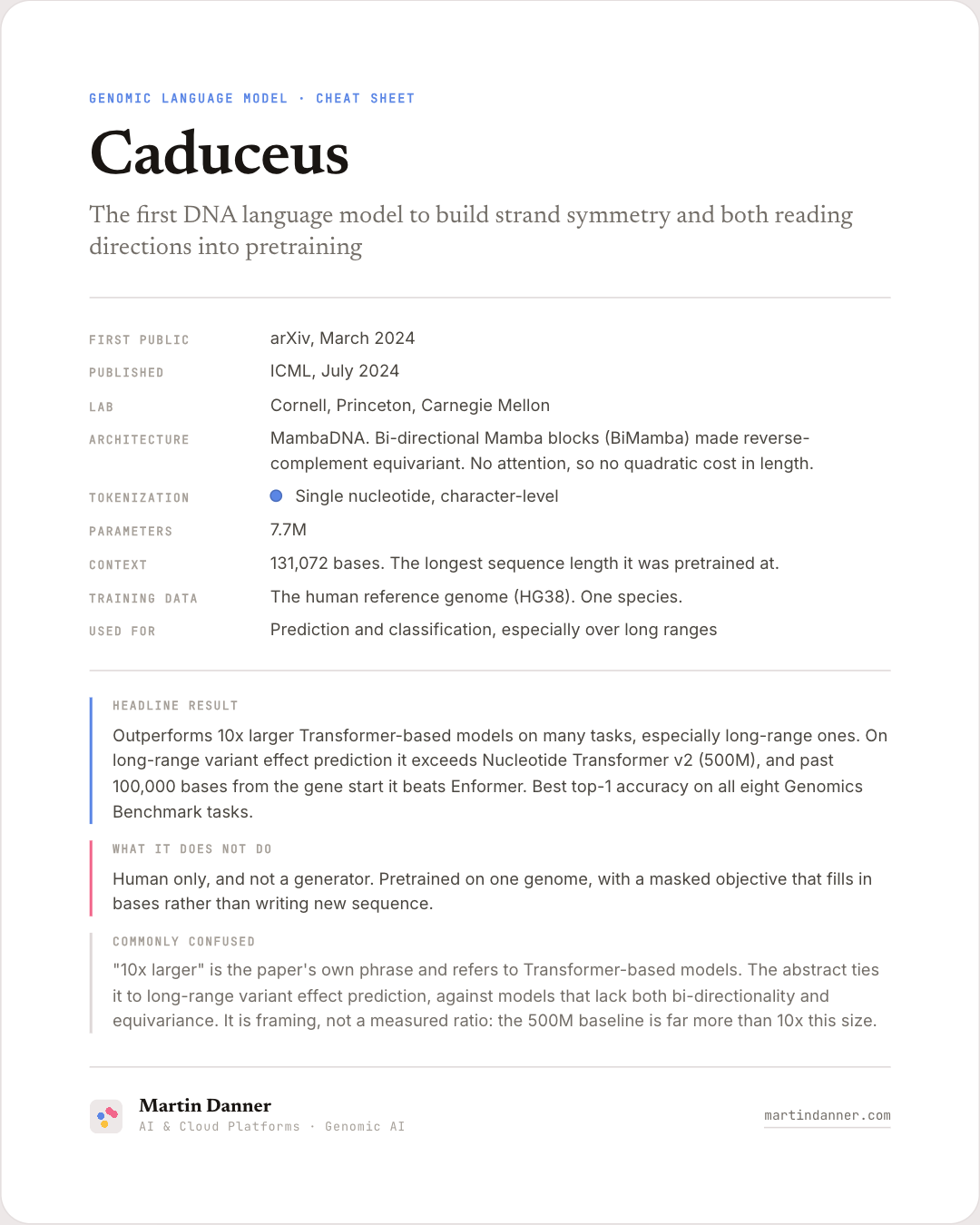
Every model in the landscape figure is one dot with a tooltip. That is enough to compare them and not enough to use one. These cards are the other half: the same ten fields for every model, in the same order, so you can read one without having read any of the others.
The colour on the tokenization row is the same colour the model carries on the landscape chart, which makes each card a zoom-in on that figure rather than a separate thing to learn.
Two of the fields matter more than the rest. Headline result gives the metric and the condition it was measured under, because the number on its own does not tell you much. What it does not do is the field summaries usually leave out, and it is often the one that tells you whether the model fits your problem.
On Caduceus specifically, the size is the part worth stating carefully. The paper reports the configuration of its largest pretrained model, 131,072 bases of context with hidden dimension 256 over 16 layers, rather than a parameter count. The 7.7M on the card is the released checkpoint of that configuration, and it is the same number the landscape figure carries, so the two stay consistent.
The design idea is the reason the model is small. DNA is double-stranded, and either strand determines the other exactly: reverse it, swap every base for the one it pairs with, and you have the second. Caduceus is built to encode that relationship rather than learn it from extra training data. It also reads in both directions at once, and shares projection weights between the two directions so the parameter count does not double. The paper’s claim is that building this structure in can beat making the model bigger, on the tasks that need long context. It keeps the hedge, and so does the card.
The paper puts this as the two strands carrying “the same information,” and that phrase is worth pinning down, because it is true of the sequence and not of the biology.
On the sequence it is exact. Write ATGC on one strand and its partner, read in its own 5’ to 3’ direction, is GCAT: reversed, and every base swapped for the one it pairs with. Either string determines the other by a rule with no choices in it, so writing down the second adds nothing to the first. A DNA language model sees only the string, so this is the version of the claim the architecture actually rests on, and in that narrow sense it holds exactly.
On the biology it does not hold, and it is worth saying so rather than letting the phrase carry more than it can. The two strands are not interchangeable in a cell. Only one of them is the template for any given gene. Genes sit on both strands, so the same stretch of chromosome can be template for one gene and coding for another. Replication, transcription and repair all treat the two strands differently. That one strand is recoverable from the other says nothing about them playing the same role.
So “the same information” is a claim about two strings being equivalent descriptions of one molecule, not a claim that the strands are equivalent. Which of the two descriptions ended up in your file is a convention of the annotation pipeline rather than a property of the DNA, and that is the thing a model’s answer should not turn on.
The card says equivariant, not invariant, and the difference is the whole mechanism. An invariant model would return the same output for a sequence and for its reverse complement. Caduceus is not that. Theorem 4.1 of the paper states that flipping the input to its reverse complement flips the model’s predictions to match: reversed along the length of the sequence and complemented, A to T and C to G. The output changes, in a way you can predict exactly. That is what lets the model skip reverse-complement data augmentation during pretraining, because its predictions are already symmetric with respect to the operation.
This is also the answer to the obvious objection, which is that DNA is not strand-symmetric at all. Transcription runs off a defined template strand, promoters and splice sites and start codons all have an orientation, and genes sit on both strands throughout the genome. That objection is an argument for equivariance rather than against it. An invariant language model would erase orientation, because invariance is a projection and projections discard information. Equivariance preserves it: read the other strand and a representation of “promoter pointing rightward” becomes “promoter pointing leftward.” The direction is not lost, it is re-expressed in the flipped coordinates.
Invariance is what you want at the other end, and the paper is explicit about it: for a downstream task, either strand of an assayed sequence carries the same label, so the answer should not depend on which strand you read. The two models get there differently. Caduceus-PS splits its final hidden states, which are twice the usual width because of the parameter sharing, and averages the two halves. Caduceus-Ph uses post-hoc conjoining: it runs the model on the sequence and on its reverse complement at inference time and averages the two predictions. So equivariance is the property of the language model, and invariance is built on top of it for the actual prediction.
That last step is where the design makes an assumption worth naming, and the paper names it in one clause: “since either strand of an assayed sequence will carry the same label, we wish to enforce RC invariance.” The assumption holds comfortably for labels that belong to a locus rather than to a strand, such as whether a region is accessible, whether it binds a given protein, or whether a variant shifts expression. It is doing real work when the label is genuinely strand-specific, because averaging is a projection and a projection loses information either way. The paper’s own benchmarks are locus-level, so the assumption fits what it is tested on. It is not free in general.
Variants are a good case for seeing where the symmetry does and does not apply. A substitution changes a base pair, so it alters both strands at once, which makes the variant itself strand-symmetric. Its consequence is not, because that depends on which gene on which strand it falls into. The model is not blind to this: the gene’s orientation is part of the surrounding sequence window, and equivariance preserves it. What the model is deliberately blind to is which of the two equivalent descriptions of that window it was handed.
The “10x larger” claim is worth reading closely, because the paper states it twice and the two statements are not the same. The introduction says Caduceus “outperforms 10x larger Transformer-based models” on many tasks, especially long-range ones, and this is the version the authors use on their own project page. The abstract is narrower: on a long-range variant effect prediction task, Caduceus “exceeds the performance of 10x larger models that do not leverage bi-directionality or equivariance.” Both are the paper’s own words. The card carries the Transformer version as the result and the condition as the correction, because 10x is a framing rather than a measured ratio: the model it exceeds in that experiment is Nucleotide Transformer v2 at 500M parameters, which is much more than ten times the size of Caduceus.
One more result is worth having in mind and did not fit on the card. On the eighteen Nucleotide Transformer tasks, Caduceus beats attention models with orders of magnitude more parameters on eight of them, not on all eighteen.
Numbers are from the ICML paper. Sizes are the largest reported checkpoint, and release is the first public preprint, matching the conventions used on the landscape figure.