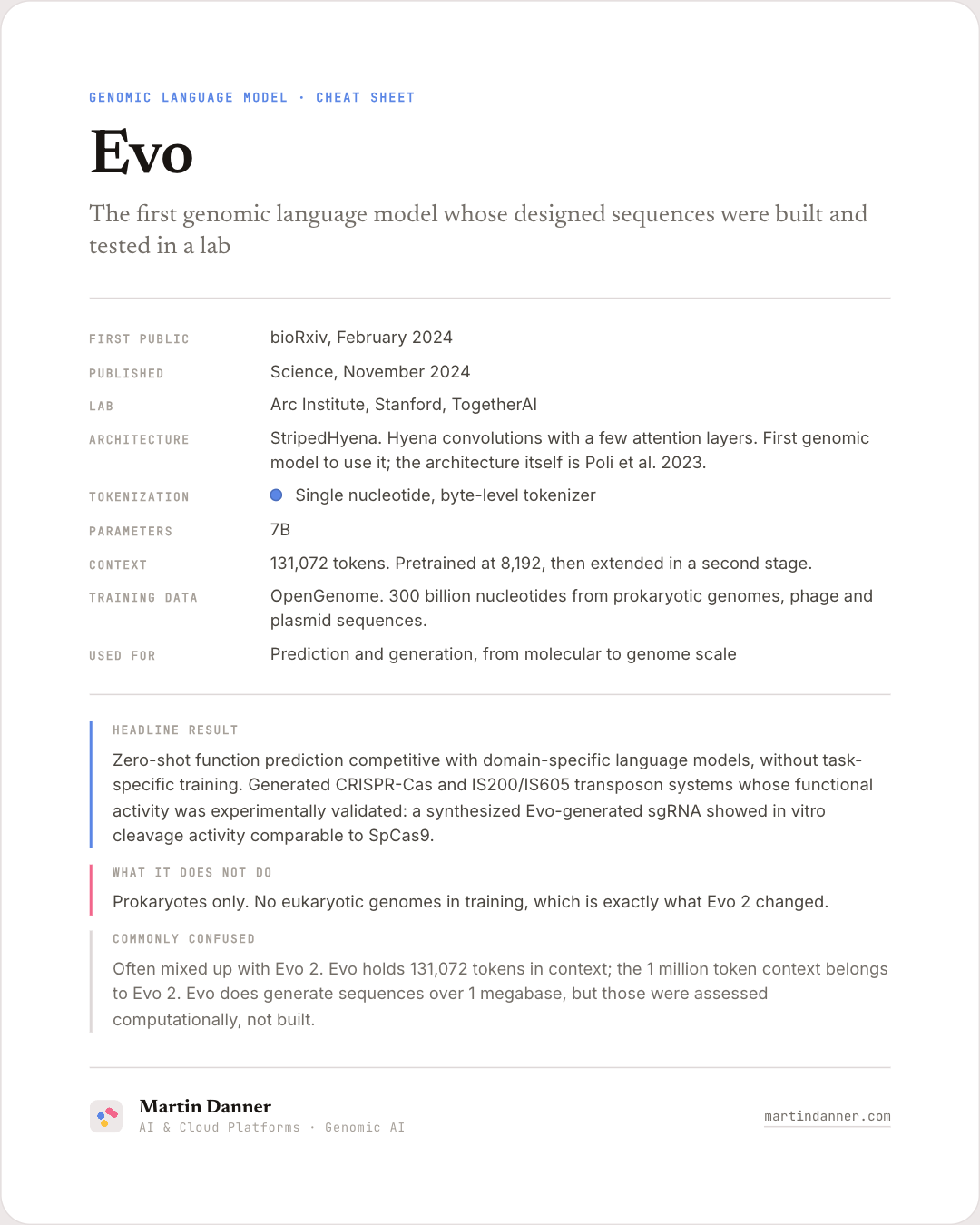
Every model in the landscape figure is one dot with a tooltip. That is enough to compare them and not enough to use one. These cards are the other half: the same ten fields for every model, in the same order, so you can read one without having read any of the others.
The colour on the tokenization row is the same colour the model carries on the landscape chart, which makes each card a zoom-in on that figure rather than a separate thing to learn.
Two of the fields matter more than the rest. Headline result gives the metric and the condition it was measured under, because the number on its own does not tell you much. What it does not do is the field summaries usually leave out, and it is often the one that tells you whether the model fits your problem.
On Evo specifically, one thing is worth stating plainly because it goes wrong often. Evo generates sequences longer than 1 megabase, and its context window is 131,072 tokens. Those are different numbers and they get merged. The 1 million token context belongs to Evo 2, on StripedHyena 2. Evo is also the first genomic language model built on StripedHyena, though the architecture itself came from Poli et al. in 2023 and was built for text first.
Numbers are from the Science paper. Sizes are the largest reported checkpoint, and release is the first public preprint, matching the conventions used on the landscape figure.